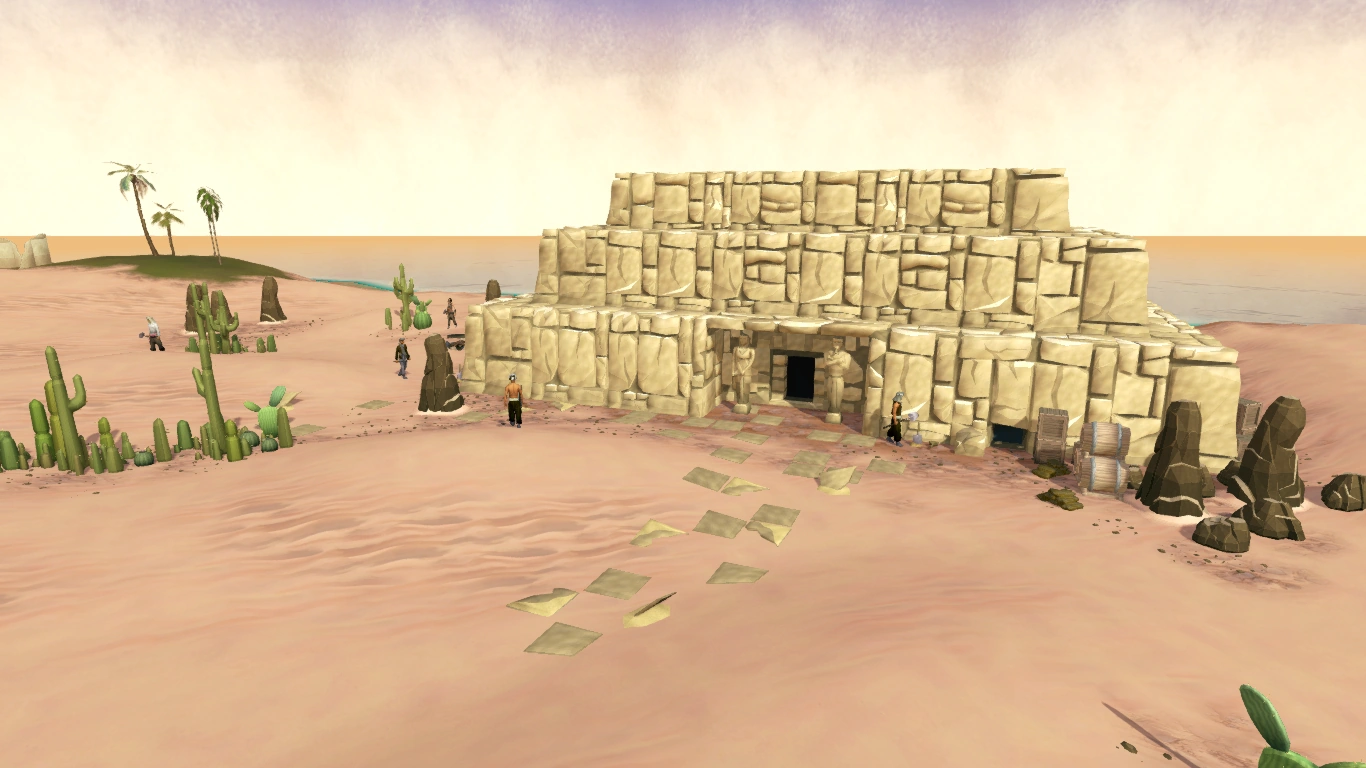

Uzer Mastaba, a Second Age-pyramid built to house the mummy of Pharaoh Queen Senliten.
Mummification is a process by which corpses can be preserved for long periods of time. In RuneScape, mummification has been practised by the Menaphite people of the Kharidian Desert since the early Second Age, when the Kharidian Empire flourished under the rule of the Menaphite Pantheon. The process of mummification is complex, and is intended to preserve both the physical body of the deceased as well as their spirit so that they can inhabit the afterlife.
According to the religion of the Menaphites, humans may only enter the afterlife if their corpse is preserved through mummification.[1] Historically, most of those to undergo the mummification process have been of great importance,[2] due to both the cost and complexity of the process as well as the Menaphites' belief that only those considered "worthy" may enter the afterlife.[3]
Because the process of mummification is so important to the people of the Kharidian Desert, it has played a major role in the region's development. The Kharidian Desert's religion, economies, politics, and architecture have all been influenced by the process's significance.
History
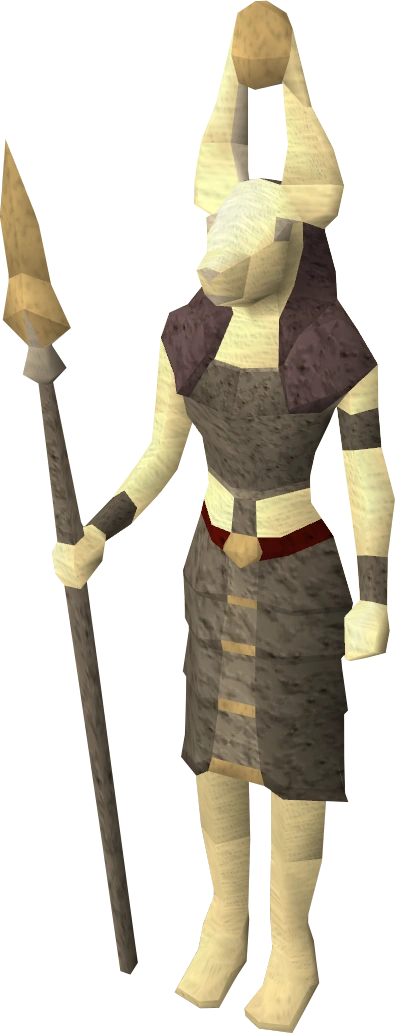

A statue depicting Icthlarin.
Mummification has been practised in the Kharidian Desert since the early Second Age, when, according to the story of Tumeken's Dream in the Book of Light and Day, the deities Tumeken and Elidinis had a child named Icthlarin.[4] Icthlarin's duty as a deity was to transport the souls of the deceased to the afterlife.[5] However, only those with both the mental preparation and physical treatment could be made to permanently inhabit the afterlife; if this was no the case, they would be reincarnated in Gielinor.[6] It is from this requirement that mummification was born.
Through a variety of scientific and religious processes, mummification was created. Most of the materials needed to perform mummification, such as spice, salt, and sap, were readily obtainable in the Kharid. As time has progressed, the spiritual processes involved with mummification have been simplified to a degree, although it is unclear how.[2] Originally, the mummies of the deceased were buried beneath the surface in a more traditional fashion. As time progressed, however, more complex, ornate tombs were developed, such as those still accessible in the cliffs of Uzer. During the reign of Pharaoh Queen Senliten, the concept of the mastaba was developed.[7] This idea later developed into the pyramid, a similar structure differing only in appearance. The mastaba was a massive, flat-topped pyramid built with portions both above and below the surface. The first mastaba, found near the settlement of Uzer, was built to house the mummy of Senliten. It was protected through a variety of means, including magical, spiritual, and physical defences. Many concepts from the Uzer Mastaba were emulated in later pyramids, such as Jalsavrah.
After its development, mummification was practised throughout the desert, although it was practised most elaborately in cities such as Uzer and Ullek. The corruption of the mummification process first emerged in the early Second Age, when it was found that mummification could be manipulated so as to trap beings between life and death.[8] The Mahjarrat, who had been brought to Gielinor from Freneskae by Icthlarin during the early Second Age, soon became adept at this art.[9] During the late God Wars of the Third Age, the Kharidian Desert Campaign resulted in the destruction of many northern desert settlements. Shortly after the Battle of Uzer in roughly the Year 3669 of the Third Age,[10] the city of Ullek was destroyed by Zamorakian forces, including the demon Balfrug Kreeyath. Refugees from Ullek and other settlements fled to Sophanem,[11] a small village in the southern desert that had existed since the early Second Age. As time progressed, Sophanem and its newly established neighbour, Menaphos, became the new centre of the Kharidian Empire. Sophanem became famous for its mummification industry, which became so large that it earned the moniker "City of the Dead."
During the Fourth Age, Sophanem and Menaphos were amongst the most prosperous cities in the world. Because of its booming mummification industry, Sophanem became an economic hub, attracting visitors from both within and beyond the Kharidian Desert. Though Menaphos gradually became the larger and more significant of the two cities, it remained largely dependent upon Menaphos's industry. Today, mummification is still practised throughout the Kharidian Empire, and remains a hugely important part of Kharidian society.
The mummification process
Mummification
The process of mummification is complicated, and involves a variety of physical and spiritual treatments. Although the specifics of mummification can vary by age and individual, most aspects of the process are fairly consistent.
The first major physical step in mummification is the removal of the body's major organs, which aids in the corpse's preservation. Incisions are made on the corpse, allowing the stomach, lungs, liver, and intestines to be removed effectively. These organs are stored in four blessed canopic jars, which are typically designed in the likenesses of the deities Het, Crondis, Apmeken, and Scabaras.[12]
Following the removal of the corpse's organs, salt is thoroughly applied to it. Salt helps to further dry out the body, which is crucial in preventing its decay. Salt is valuable amongst the Menaphites, and has generally been gathered from bodies of water such as the lake north of Sophanem. The process of separating the salt and water has historically taken an extended length of time, but in recent years salt has been more readily obtainable through the use of sun-focusing devices such as the one found in south-eastern Sophanem.
After the corpse has been drained of fluids and properly prepared, it is wrapped in linen, which helps to further slow decay. Furthermore, sap is used to encase the corpse either before or after the application of linen. Up until the late Third Age, pine forests dominated the south-eastern Kharidian Empire,[13] presumably providing a source of sap. Climate change has since led to the loss of the area's forests, making sap a much more expensive commodity in the present day.
Spiritual treatment
Although spiritual elements are evident throughout the physical preparation of the mummy, they are most significantly involved following the end of the physical process.